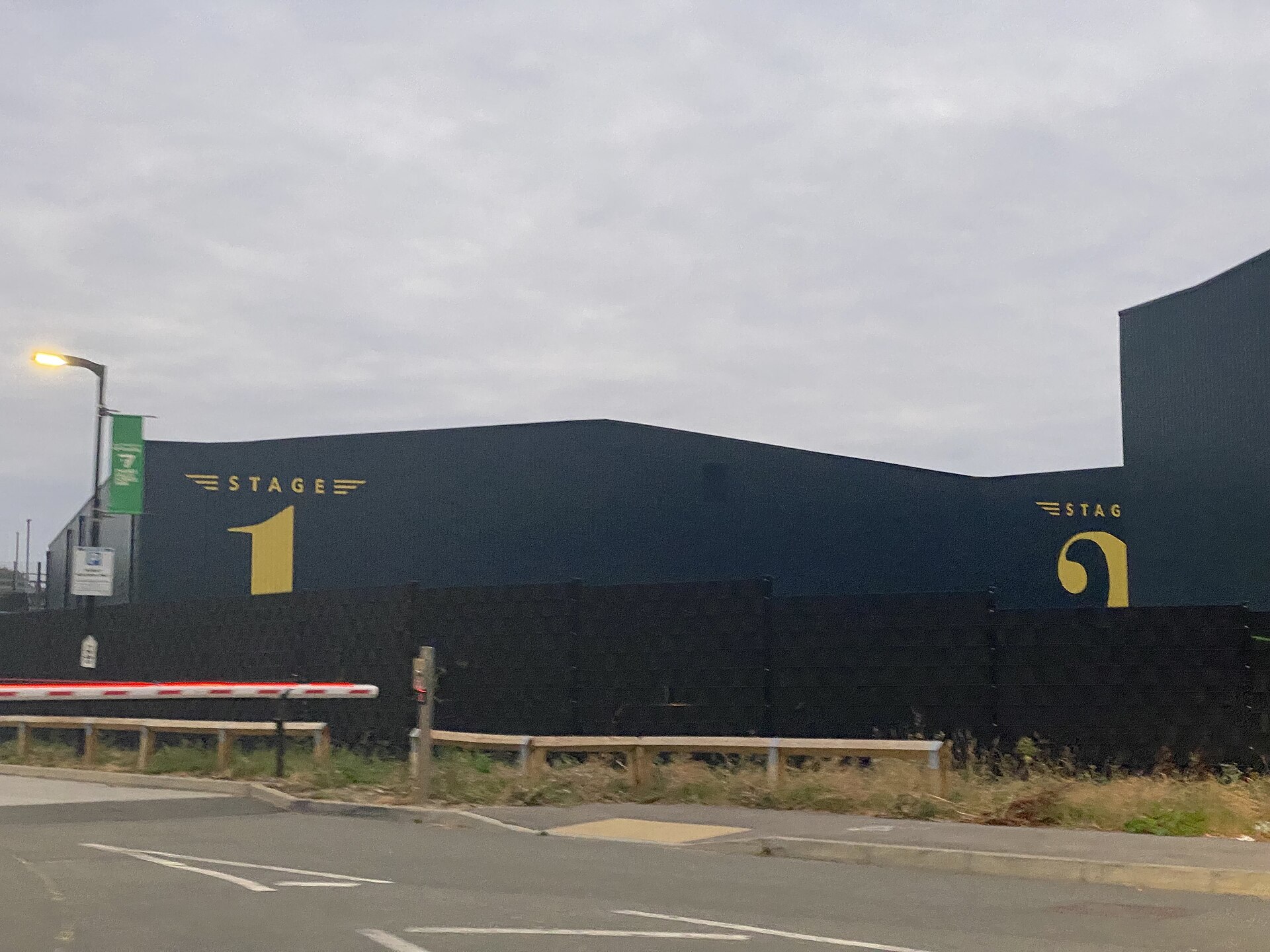
HOLLYWOOD — For two years the studio that owns Stage 7 has answered every question about the building the same way, which is to say not at all. On Wednesday, four days after the Cultural Heritage Commission set a September 17 hearing on the stage’s landmark application, it said two things.
It does not intend to demolish Stage 7. And it will oppose making Stage 7 a Historic-Cultural Monument.
Both sentences arrived in a three-paragraph statement, and the people who have spent a year and a half worrying about the building spent Wednesday afternoon deciding which one to believe.
“I’m glad they said it. I would be gladder if it were in a covenant,” said Marguerite Han, the neighborhood historian who filed the application in July and who has been careful, throughout, not to accuse the studio of anything. “A statement is a statement. It binds nobody and it expires when the person who signed it changes jobs. That is not cynicism, that is just what a statement is.”
The studio’s objection is not to preservation in principle. Its stated position — and it is a real position, held by most operators of working stages in this city — is that a monument designation adds a review layer to every alteration of a building whose entire value lies in being altered constantly. Rigging changes. Doors get widened for a set that will not fit. Floors get cut. A stage that cannot be modified quickly is a stage that does not get booked.
“Landmarking a soundstage is like landmarking a kitchen,” a studio executive said, on background, before the formal statement went out. “You can protect the room. You just have to accept that the room’s job is to be torn up on a Tuesday and put back on a Friday.”
Preservationists have an answer to that, and it is the reason the September hearing will be more interesting than most. City monument designations are not blanket freezes; the designating ordinance can specify which features are protected and which are not. Ms. Han’s application already proposes that: it seeks protection for the exterior envelope, the roof truss system, the column-free floor span and the surviving silent-era rigging points, and explicitly excludes interior partitions, lighting grids, floor surfacing and stage doors from review.
Whether the commission will adopt that framing is the substantive question. Whether the studio will accept it even if the commission does is the political one.
The application’s practical effect is already in force. Under city rules, the filing itself triggers a temporary shield: no demolition permit may quietly issue while the case is pending. That protection runs through the commission process and, if the commission recommends designation, through a council vote — a sequence that, at the pace such things move, reaches into next spring.
What has changed in the past month is the temperature among the crews. Stage 7 sits on the eastern edge of a lot whose owner has spent two years studying a redevelopment of exactly that edge, and the people who work the stage have read the silence the way anyone would. The stage has been booked continuously this year, mostly by a streaming production that finished in May and a commercial house that has it through August.
“Continuous booking is the argument,” said a rigging gaffer who has worked the stage on and off since 2004 and asked not to be named because he would like to keep working it. “Nobody has to save it out of sentiment. It pays. That’s the whole case. If it stops paying, then we’ll find out what the statement was worth.”
Ms. Han has spent the past two weeks collecting the material she expects to matter most at the hearing, and it is not architectural. It is the working record: booking histories, a list of productions that used the stage’s column-free span because nothing else on the lot could take it, and eleven statements from crew members, four of them from people who first worked the building in the 1970s.
One of those, from the retired grip whose line about the floor has been quoted at every meeting since the filing, has been shortened for the record to a single sentence. It reads: “You are not protecting a box, you are protecting the last place in this town where the old way still fits through the door.”
The commission meets at ten in the morning on September 17. Public comment is expected to run long.