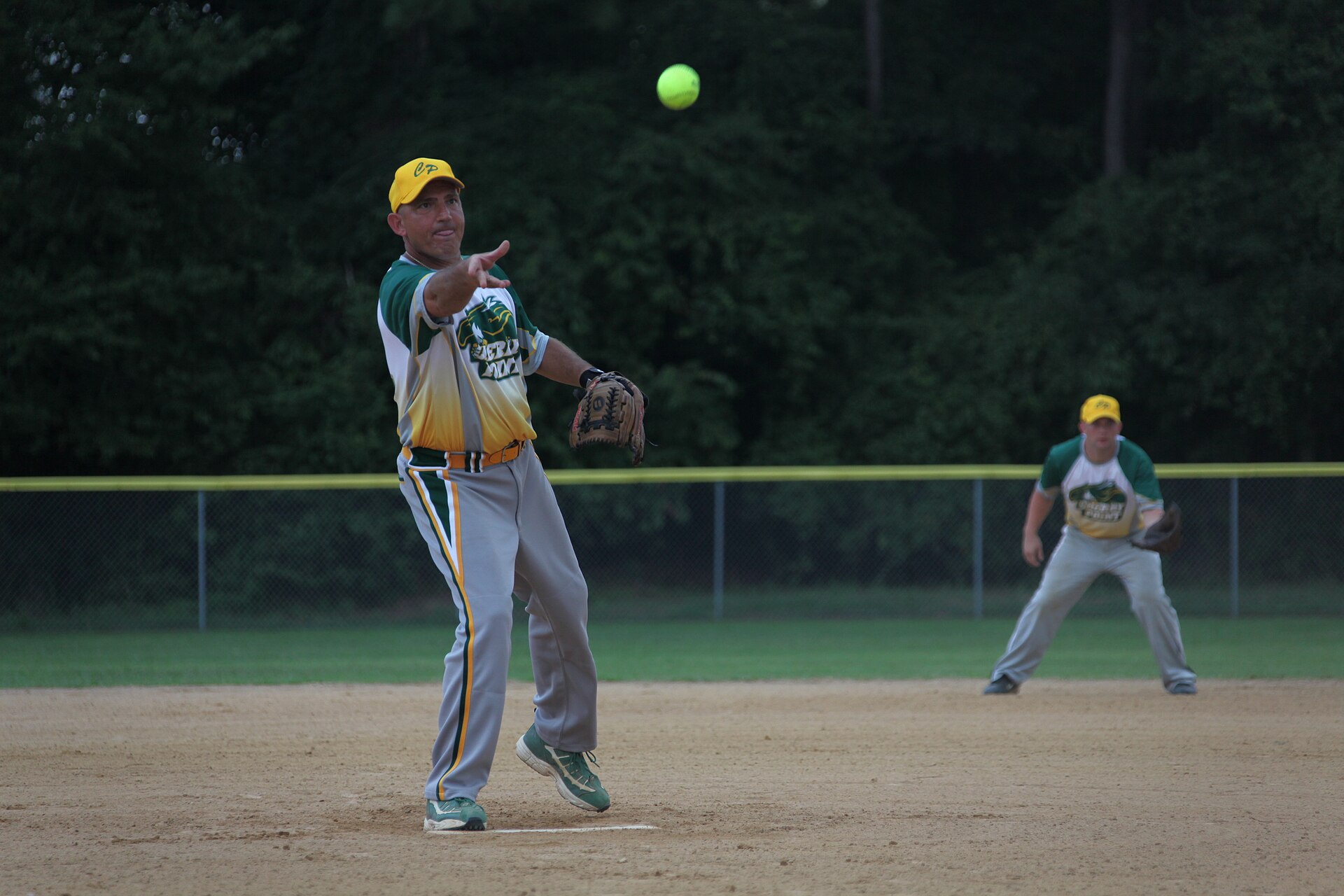
HOLLYWOOD — The manager of the first-place team spent Tuesday evening on the phone, and not about the championship.
“I need nine men who can run,” said Ignatius Broadfoot, 71, who has managed in this league for nine years and who was, at the time, working down a list of eleven names. “I have fourteen on the roster. Two are in Oregon visiting grandchildren. One had a hip replaced in May and is cleared to bat but not to run, which means I need a pinch runner every time he reaches, which means the runner is also playing a position. One rolled an ankle in the last game of the regular season chasing a foul ball he had no business chasing, and I told him at the time.”
This is the shape of a title week in the sixty-and-over league, which plays Thursday evenings at a field off Fountain and which this newspaper has covered, on and off, since the standings first started to matter to somebody. Four teams. Fourteen-game regular season. A single Thursday for the semifinals and the final, both on the same night, which the league adopted in 2019 after discovering that a two-week playoff format produced more injuries in the second week than the whole season had in the first.
The standings, for the record: Broadfoot’s team at 11–3, a team sponsored by an auto body shop on Santa Monica at 10–4, and two teams tied at 6–8 who will play a coin-flip game for the fourth slot that neither wants to play in the heat.
The injury report, also for the record, is eleven names across the four rosters. One hip, two knees, an Achilles that everybody agrees is only a scare, a hamstring, a wrist, two shoulders, an ankle, a back that has been on the report since 2023 and belongs to a man who has not missed a game, and one entry listed simply as “not saying.”
“That’s Vernon,” Mr. Broadfoot said. “Vernon is sixty-eight and Vernon is going to play, and I have decided as a matter of policy not to know what is wrong with Vernon.”
The league’s rules have accumulated in the way that rules accumulate when the people writing them are the people affected. Base paths are 65 feet rather than 70. There is no sliding, at all, ever, in any circumstance, and the penalty is an out and a conversation. A runner who reaches first may be replaced by a designated runner without the batter leaving the game, an accommodation that started as a courtesy for two men in 2016 and is now used by roughly a third of the league. Pitching is slow-arc, which is not a concession — it is the game — but the arc window was widened two years ago after a season in which the umpires’ strike-zone calls produced more arguing than anybody was enjoying.
And there is the heat rule, which is newer and which the league takes more seriously than the injury list. Games above 95 degrees at first pitch are postponed. Two were postponed last month and made up on consecutive Thursdays, which is why the championship is being played on the sixth of August rather than the last Thursday of July, which is why two men are in Oregon.
What makes the thing worth watching, if you go, is not the baseball, although the baseball is better than a person expects. It is the specific quality of a competitive game played by men who have every one of them decided, individually and against some advice, that this is what Thursday is for.
“My doctor asked me what I get out of it,” said a 74-year-old catcher on the fourth-place team, who has played in the league since 2011 and who wanted his name kept out of it because his daughter reads the paper. “I told him I get Thursday. He wrote something down. He did not tell me to stop.”
First pitch of the semifinals is at 5:30. The final follows immediately, or as immediately as fourteen men in their sixties and seventies can be persuaded to take a field for a second time in an evening, which Mr. Broadfoot estimated at “forty minutes, and I am being optimistic.”
Admission is free. There are perhaps thirty seats and one shade tree, and the tree, by long custom, belongs to whoever’s wife arrives first.