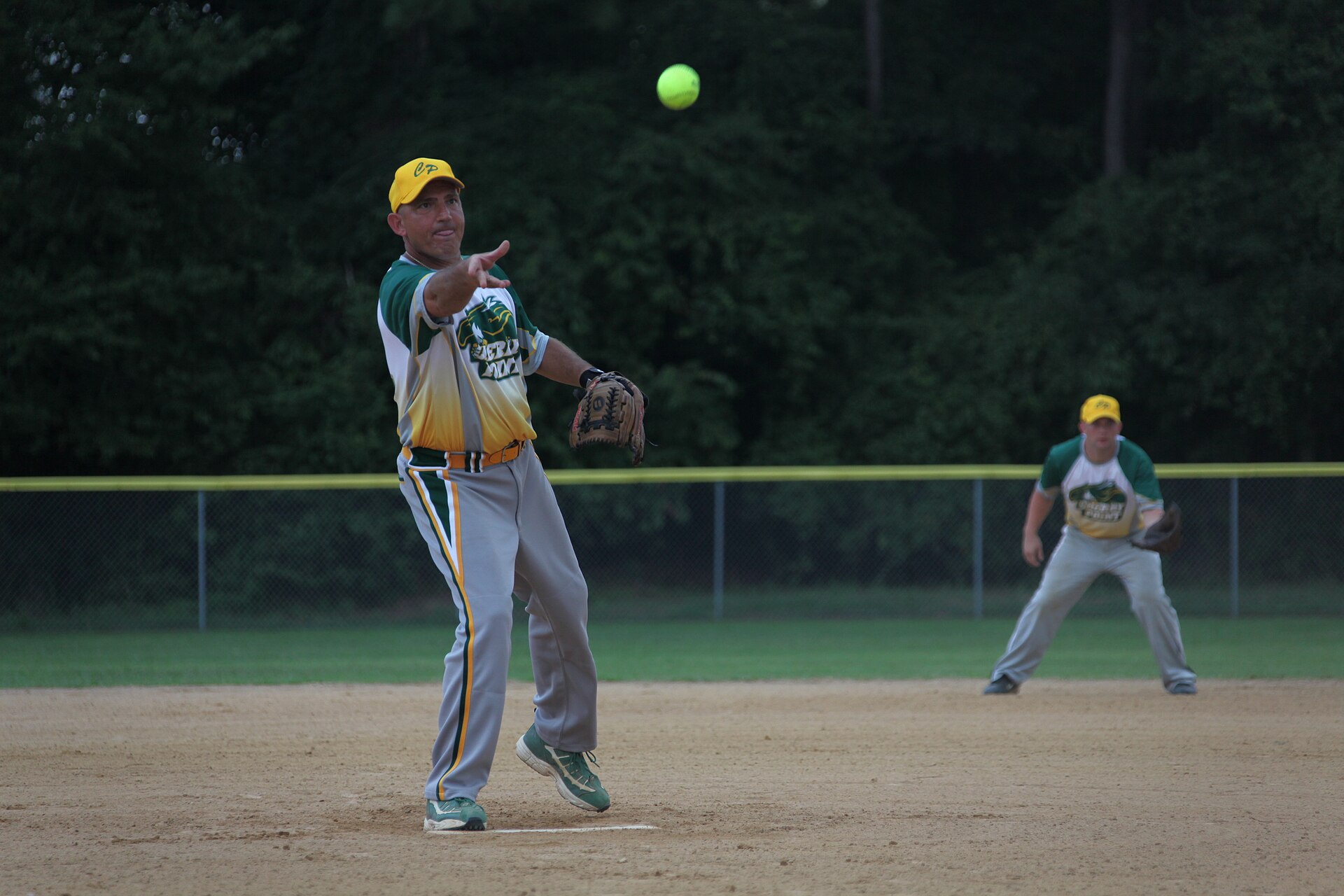
HOLLYWOOD — The lights came on over the diamond around seven, roughly a half-inning before anyone could reliably track a fly ball, and the Tuesday coed softball league went on hitting into the dusk anyway.
The league fields ten teams on a public diamond near Los Feliz, most of them named for the neighborhood business that covers the entry fee and, more to the point, the tab afterward. Slow-pitch, coed rules, a fifteen-run mercy limit invoked more often than anyone admits. Games run seven innings or fifty minutes, whichever mercy arrives first.
“We tell new people it isn’t competitive, and then we absolutely do not mean it,” said Lena Ostrander, 39, who captains a team sponsored by a coffee bar and plays shortstop with a brace on each knee. “You come out to blow off work. Then somebody on the other side starts calling their own foul balls fair, and suddenly you care very much.”
The rosters run wide. Some players were varsity somethings twenty years ago and can still turn a clean double play; others are here because a coworker was a body short and swore it would be fun. The coed format keeps the sides mixed by rule, and the better teams have learned that a lineup is only as strong as its least confident hitter.
Rich Calloway, 52, has played eleven summers and bats cleanup for a team out of a print shop. He tore a calf two years ago legging out a double that he described, unprompted, as “a stand-up double the whole way, ask anyone.”
“At my age the injuries are the box score,” Calloway said. “You don’t remember who won. You remember the pull you felt rounding first, and how long it took to walk right again.”
The field shows its age by July. The infield is more dust than grass, a bad hop is always a possibility, and the outfield lights leave a seam of shadow in right-center where routine flies disappear. Players compensate the way weekend athletes do, blaming the equipment and the lighting in roughly equal measure.
What holds the league together is the hour after the last out, when both teams drift to whichever bar or taqueria had its name on the jerseys. The winners buy the first round more often than not, an unwritten rule that softens the standings considerably.
Maya Escárcega, 28, joined this season knowing no one and now runs the postgame for her team. She said she has learned more names at the table than on the field.
“On the field everybody is a position,” she said. “At the table they turn into a person with a strange job and a dog. I signed up for the softball. I stayed for the second part.”
By nine the lights clicked off on a timer, whether or not the inning had finished, and a disputed final score went to the place most disputes out here go — the bar, where it was relitigated loudly and settled by nobody.