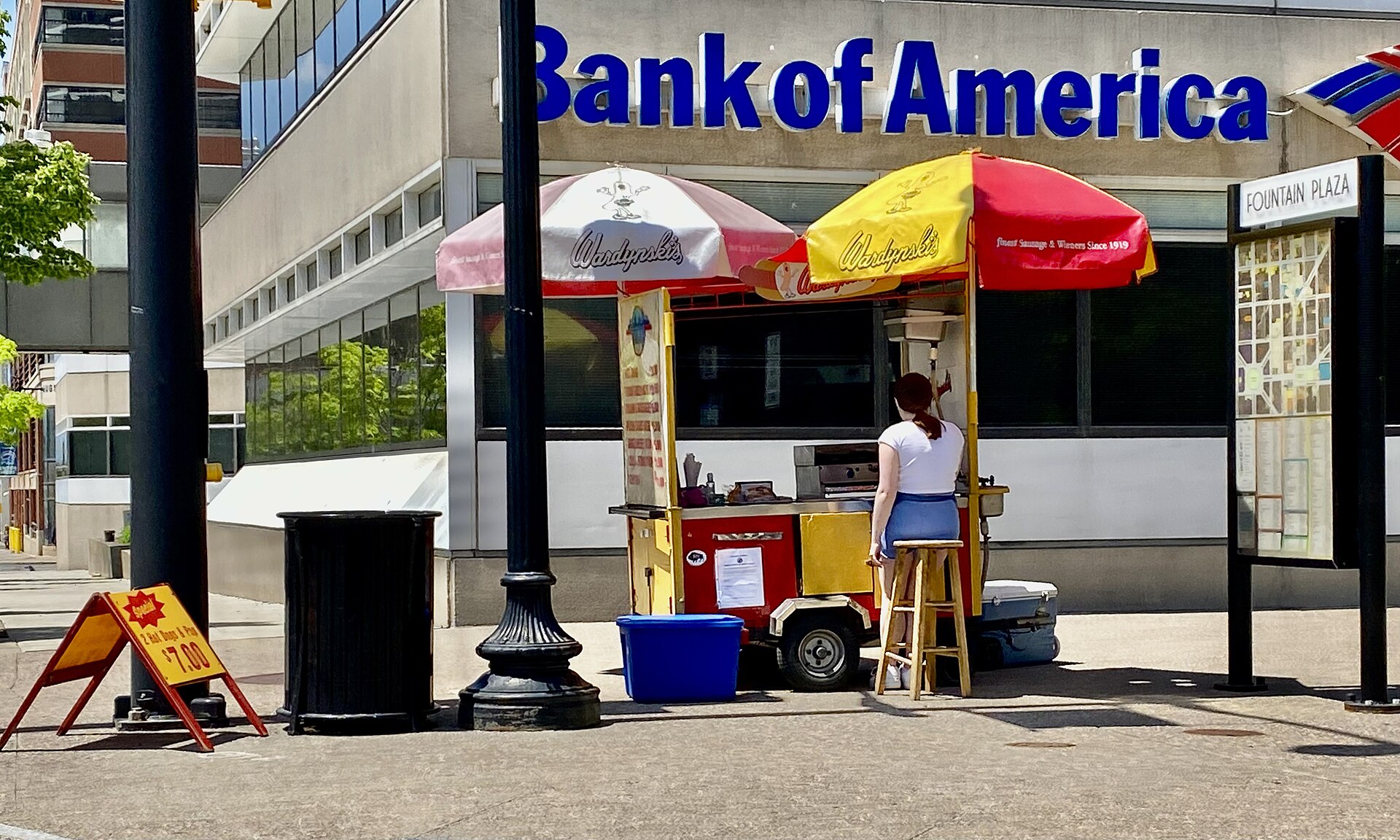
LOS ANGELES — The city expected to issue about 120 sidewalk vending permits in Hollywood in the first month of its rewritten system. Two weeks in, it has issued 41.
The shortfall is not a shortage of applicants. There is a line most mornings outside the temporary permit counter the city opened on Wilcox, and it starts forming around seven for a window that opens at nine. The shortfall is a document.
Under the overhaul that took effect on the 15th — with Hollywood designated the test district before a citywide rollout — a vendor selling prepared food needs three things that used to be obtained in three separate places over many months: a sidewalk vending permit from the city, a county health permit for the cart itself, and proof that the cart is stored and serviced overnight at a licensed commissary. The reform’s central promise was to let a vendor start all three in one visit.
It does. What it cannot do is make the second one arrive faster. County health permitting for a food cart runs, by the county’s own posted estimate, six to ten weeks, and the cart must be inspected in person. So a vendor can now complete the city’s part of the process in one morning and then wait two months to legally use it.
“I have my paper. It is a beautiful paper,” said Efraín Cordero, who has sold cut fruit from a cart on Selma Avenue for nine years and applied on the first day. “The inspector comes the twenty-eighth of August. Until then my beautiful paper says I am allowed to do the thing I am not allowed to do.”
City staff at the counter have been candid about this, which is to their credit and does not help. They have taken to writing the county’s phone number on a card and handing it over with the receipt.
Councilmember Alicia Rendón, who carried the ordinance, said the sequencing problem was known and underestimated. “We wrote a city process and we wrote it well,” she said. “We did not have the authority to write the county’s, and we told ourselves the two would meet in the middle. They are meeting in the middle in about nine weeks.”
Her office has asked the county for a temporary inspection surge in the test district — additional inspectors assigned to Hollywood carts through September — and has had no answer. A county spokesperson said the department “is reviewing the request in the context of existing caseloads,” which is the sentence a department uses when it has one inspector and four hundred carts.
The 41 permits issued so far break down in a way that tells the story. Twenty-nine went to vendors selling packaged goods, flowers, T-shirts or produce that requires no health permit at all — the merchandise side of the trade, which the new system genuinely has unclogged in a fortnight. Twelve went to food vendors who already held a valid county permit, most of them people who had spent two or three years fighting through the old process and now simply needed the city’s piece.
Nobody who started from zero on a food cart has been able to finish.
There is also the matter of the fee. The overhaul set the annual city permit at $291, down from a combined figure that could exceed $700 depending on how many separate approvals a vendor needed, and allowed payment in three installments. That change has been broadly welcomed. It has also surfaced a category of applicant the ordinance’s authors did not have in mind: a handful of longstanding sidewalk businesses that are not what most people picture as street vending — a shoe-shine stand, two flower stalls that have held the same corners for decades, and the Boulevard’s last newsstand, whose operator learned this month that she is, in the language of the new code, a sidewalk vendor.
Enforcement, meanwhile, has been paused. The department confirmed that citations for vending without a permit are suspended in the test district through September 30 while the backlog clears, with the exception of blocked-access and health complaints. Two vendors interviewed on Cahuenga said they had not heard this and had been keeping their carts off their usual corners.
Asked what the first two weeks had taught the city, Ms. Rendón gave an answer that will be tested in the other fourteen districts.
“That we built the front door and forgot we don’t own the hallway,” she said.