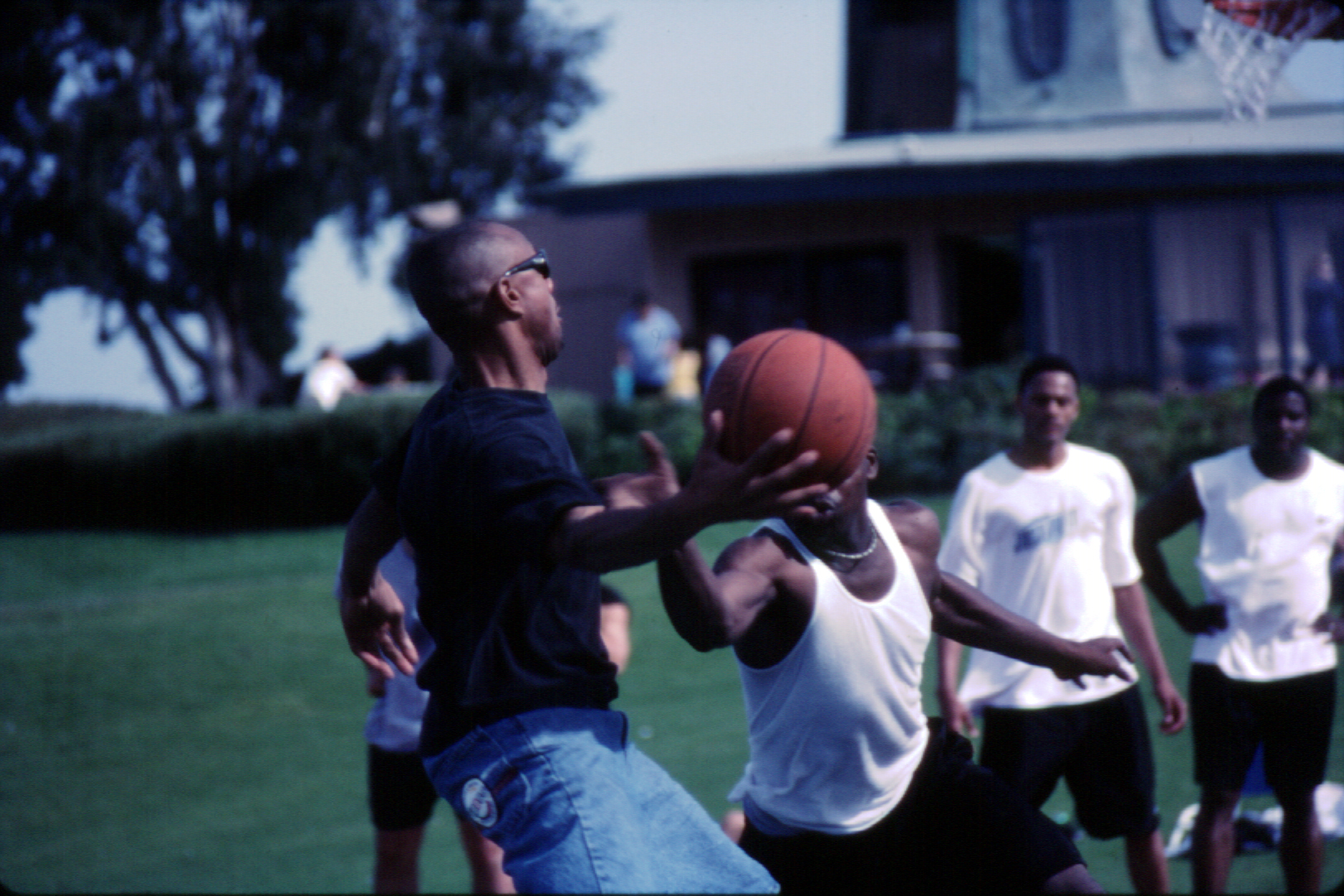
HOLLYWOOD — Nobody rings a bell at Poinsettia Park. The game just starts, the way it has started on summer evenings for forty years, once enough players have laced up to make two teams of five and somebody shoots for who gets the ball first.
The pickup run at Poinsettia has no league office and no commissioner, and the men who play there treat that absence as the point. Winners keep the court. You call your own fouls. A disputed call is settled by shooting for it, and anyone who can’t live with that outcome is free to find one of the many gyms in this city that employ referees.
“People ask who runs it, and the answer is nobody, and that’s why it’s still here,” said Cornell Battie, 61, who says he has played or watched at these courts most summers since the mid-1980s. He now mostly watches, from a folding chair he brings himself. “The second you put a guy in charge, you get politics, you get fees, you get a sign-up sheet. This is the last thing around here nobody figured out how to charge for.”
The run has its own memory, kept entirely in the heads of the regulars. There are legends — a mailman with an unblockable turnaround, a set of brothers who never lost at two-on-two, a summer when a guy who “played somewhere overseas” showed up for a week, humbled everyone, and vanished. None of it is written down. All of it is agreed upon.
The competition is real. On a good evening the level of play draws a crowd along the fence, and a spot in the next game can be worth an hour’s wait.
“I’ve played in rec leagues with jerseys and a scoreboard, and the ball out here is harder,” said Deshawn Pryor, 24, who lives nearby and comes most nights. “No refs means no bailouts. You get fouled, nobody’s blowing a whistle for you. You learn to finish through it or you go home.”
The neighborhood around the park has grown more expensive, the apartments pricier, the cars along the curb newer. The court has stayed free, which the regulars note is not nothing. Battie has watched the crowd change over the decades — more faces, more languages on the sideline — without much changing on the court itself.
“The game sorts everybody out the same way it always did,” he said. “Can you play or can’t you. Nothing else comes up out here.”
There have been scares. A few years back a proposal floated to resurface the courts and, in the same breath, to program them with organized clinics on weekend evenings. The regulars turned out to the parks meeting, said their piece, and the clinics landed on weekday mornings instead, leaving the evening run alone. It was, Battie said, the only meeting most of them had ever attended.
On the Fourth, the courts filled early and stayed full into the dark, the games running past the point where the ball became more sound than sight. No one kept a season record, because there is no season — only another evening, and then the next one.