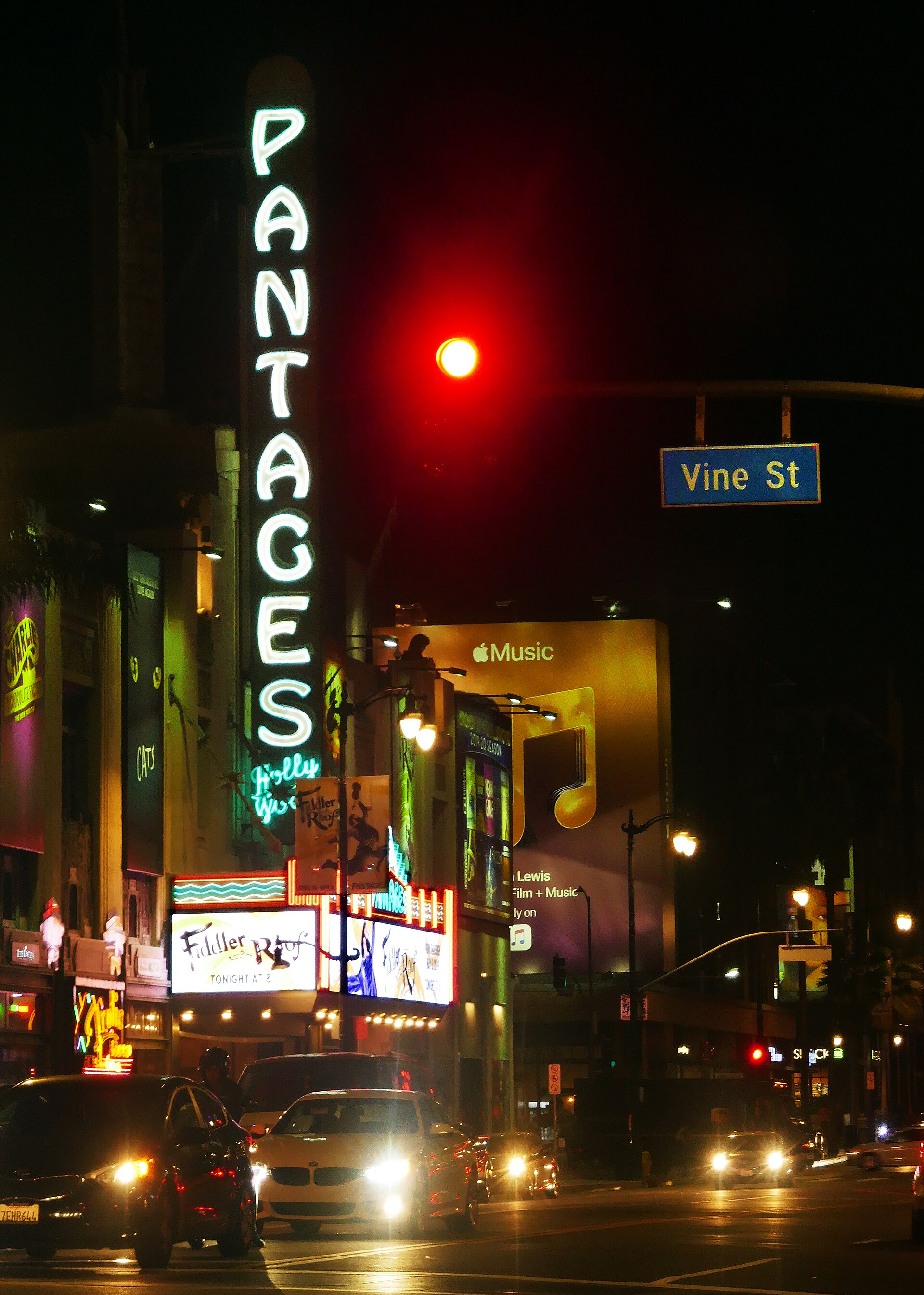
HOLLYWOOD — Marvin Sokol spent his life bending glass tubes over open flame until they held light, and he could tell you, block by block, which of the Boulevard’s signs carried his work.
Mr. Sokol, a neon craftsman — a “tube bender,” in the trade’s plain term — who shaped and repaired the glowing signs of Hollywood for sixty years, died July 6 at a hospital in Burbank. He was 89. His nephew said the cause was pneumonia.
The work he did is older than most of the businesses it advertised and rarer every year. Neon is made by hand: a straight tube of glass, heated over a flame until it softens, bent to match a pattern chalked on a fireproof board, then filled with gas and charged until it glows. A bad bend cracks. A rushed one shows. Sokol learned the craft as a teenager from an uncle who told him the two requirements were steady hands and a tolerance for burns, and he acquired both.
Over the decades his tubes went up along the Boulevard and the side streets around it — theater marquees, cocktail-lounge signs, the window script of shops long since closed. He did repairs as often as new work, climbing to a darkened sign at dawn to find the one bad section and match a replacement tube to glass blown fifty years earlier. Matching an old color, he said, was the hard part; the reds were easy, but the soft blues and the ambers had a way of aging that a new tube could not fake.
“Marvin could look at a dead sign and read it like a doctor,” said Corinne Basaraba, who runs a sign shop where he did contract work into his eighties. “He’d say, that’s the transformer, that’s a bad electrode, that section’s cracked where the pigeons sit. He was almost always right, and he’d have the glass bent before you finished arguing.”
Marvin Sokol was born in 1936 in Boyle Heights and grew up around the sign trade when neon was the ordinary language of a commercial street, not a nostalgia. He watched it fall out of fashion — plastic and backlit boxes were cheaper, and later came the light-emitting diodes that mimic neon without the glass — and he was unsentimental in public about the change and, his family said, privately wounded by it. He thought the imitations looked dead. He could spot one from a moving car and often did, to the annoyance of whoever was driving.
In his last years he took on apprentices when he could find young people willing to learn a trade that burns you while you learn it, and he gave a set of his patterns and tools to a group that restores historic signs, on the condition that they be used and not framed. He wanted the craft carried, not memorialized.
He is survived by a sister, a nephew and two grand-nieces, and by an uncounted number of signs still burning after dark along the Boulevard, a few of which, his family said, he would want you to know he bent himself.