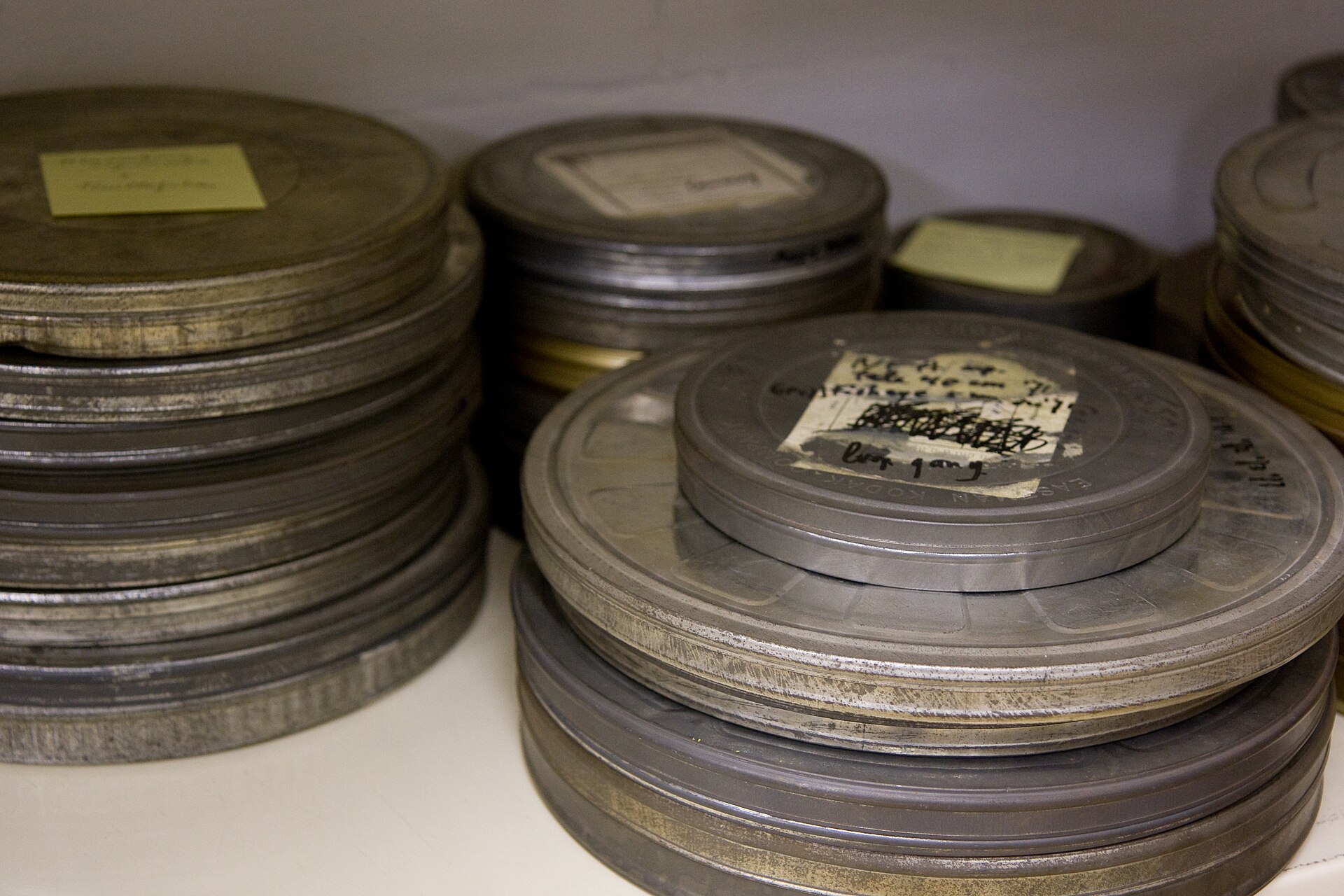
HOLLYWOOD — Ada Merritt runs a business built entirely on the past, and she spends her days worrying about how fast the future is arriving. Her company, Cahuenga Stock & Archive, occupies a low brick building where roughly forty thousand cans of film sit on steel shelving — decades of stock footage her father began collecting when a good foot of exposed celluloid was worth stopping the car for.
The footage is the unglamorous connective tissue of movies and television: freeway traffic at dusk, a crowd pouring out of a stadium, storm clouds stacking over the basin, a boulevard in the rain in 1968. When a production needs a shot it cannot afford to stage — a period street, a weather event, an aerial nobody has the budget to fly — someone like Merritt licenses a few seconds of it. For half a century that was a quiet, dependable trade. Lately it has become a race.
The race is digitization. A film can in a warehouse earns nothing; a scanned clip in an online library earns whenever a stranger in another time zone types the right words at midnight. So Merritt and her son Leo are working through the collection one reel at a time, cleaning, scanning and tagging footage that has never been anything but analog, betting that a market addicted to instant delivery will still pay for material it cannot get any other way. “Everyone wants everything now, and they want it already digital,” she said. “Our whole inventory is the opposite of that. So we spend the money to meet them where they are and hope the well is deep enough to justify it.”
She is aware of the newer pressure, and she declines to panic about it. Image-generating software can now conjure a plausible aerial or a convincing fake vintage street, and a few clients have begun asking why they should license real footage when a machine will invent something close enough. Merritt’s answer is specific rather than defiant. “If you need a documentary shot of this exact corner in 1968, the machine can’t give you that, because it wasn’t there,” she said. “It can make you something that looks like 1968. It cannot make you 1968. Some buyers care about that difference, and those are my buyers.”
A recent job proved her point. A filmmaker assembling a history of the neighborhood needed genuine footage of the Boulevard as it actually looked six decades ago — real cars, real signage, real light — and there was no generating that. Merritt found four usable cans, had them scanned and licensed ninety seconds no algorithm could have faked. It was, she admitted, a smaller check than the archive once commanded for the same reel.
Whether the digitizing pays off, she will not know for years. The collection is vast, the scanning is slow, and every month a few more clients drift toward whatever is cheapest and fastest. But Merritt keeps feeding cans into the scanner, because the alternative is letting a century of accidental history molder unseen on a shelf. “My father saved all of this on a hunch that somebody would want it one day,” she said. “I am not going to be the one who decided he was wrong.”