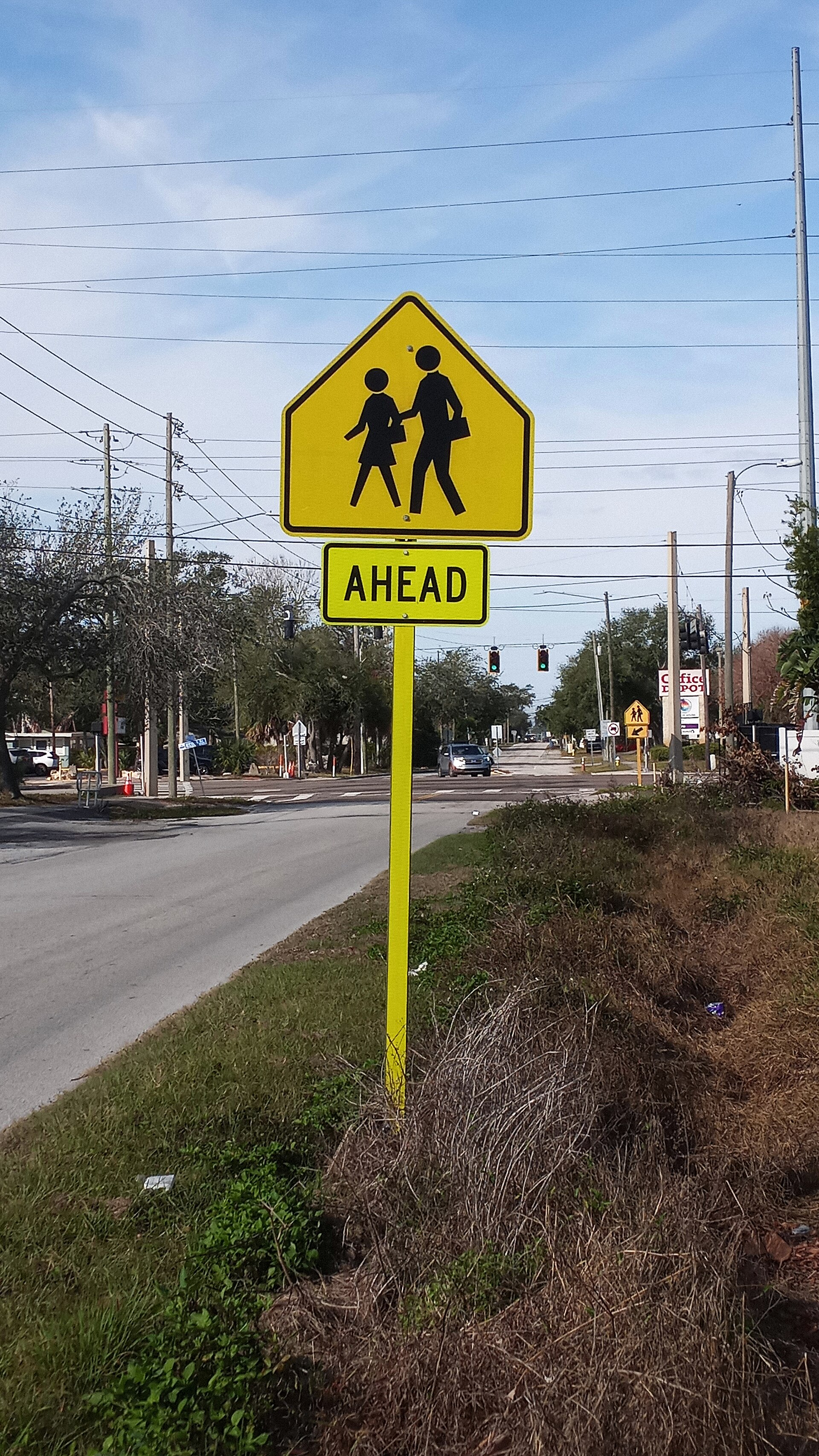
HOLLYWOOD — There is a corner near the elementary school where, for about forty minutes each morning, the most powerful person in the neighborhood wears a yellow vest and holds a hand-lettered STOP paddle, and every driver on the street does exactly what he says.
His name is Cornell Prentiss, though the children call him Mr. P, and he has worked that crossing for as long as I have been walking past it on my way to the coffee I do not need. I have taken to scheduling my mornings around watching him, which I recognize says more about my mornings than about him. He is worth the detour.
Prentiss does not hurry, and he does not let anyone else hurry either. A car noses toward the line and he gives it a look — not angry, just certain — and the car settles back like a scolded dog. Then he steps off the curb, paddle up, and walks to the center of the street at the pace of a man who has decided the street is his living room, and the traffic holds while a procession of eight-year-olds crosses under his arm as though passing beneath a drawbridge. He knows their names. He knows whose grandmother does the drop-off on Wednesdays, whose backpack is bigger than its owner, which kid needs a “good morning, sir” to stand up straight for the rest of the day.
What gets me is the calm. I have watched him settle a honking, impatient sedan and a crying first-grader inside the same half minute, lowering the temperature of both without appearing to try. There is an authority that comes from a title and an authority that comes from showing up in the same spot every day for years and plainly caring what happens there, and only the second kind can make a driver in a rush feel briefly ashamed of himself. Prentiss has the second kind. The city issues the vest. The rest he supplies himself.
I asked him once whether it ever got dull, standing on the same square of asphalt season after season. He considered it longer than the question deserved and said no, because the children were never the same children — each September a new smallest one arrives terrified of the curb, and by June is bounding across mid-sentence, and he gets to watch that happen forty times over in a morning. Then he tipped his paddle at a minivan and went back to work.
We spend a great deal of civic energy on the big, contested things — the retrofits, the repavings, the projects that draw a hearing and a headline. We spend almost none of it noticing the man who turns a hazardous corner into a safe one every single school morning for a wage this city would be embarrassed to print beside what it pays a consultant. I have no policy to propose. I only wanted to say that if you are hunting for proof a neighborhood still works, you could do worse than to stand at that corner at eight in the morning and watch a small girl trust a stranger in a yellow vest to stop the whole world for her, and watch him do exactly that.