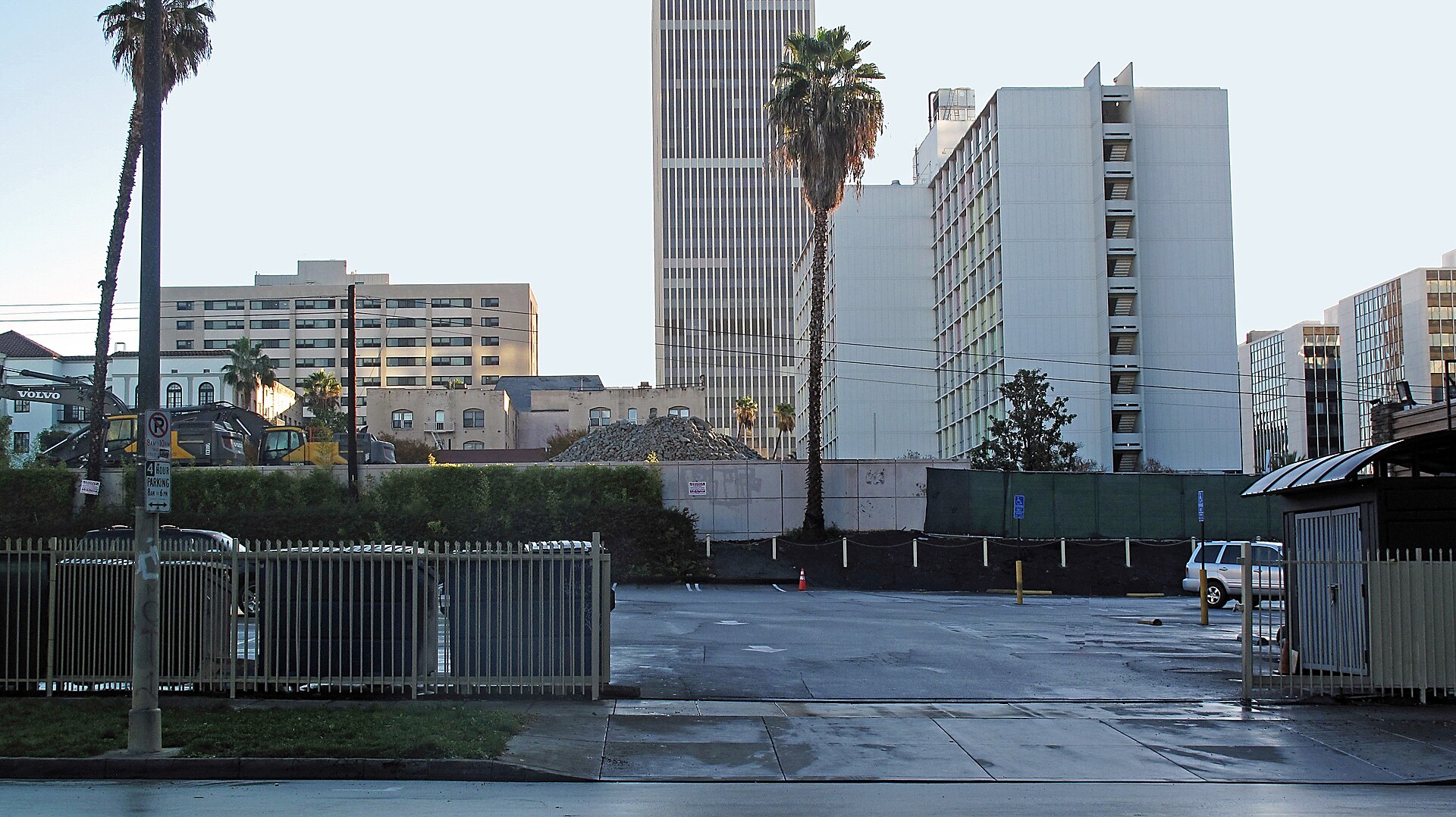
HOLLYWOOD — Ezra Pomerantz, who ran the attendant’s booth at a surface parking lot off Cahuenga Boulevard from 1961 until 2012, and who in those fifty-one years never once wrote down where he had put a car, died August 5 at his home in East Hollywood. He was 88.
His daughter, Renata, said the cause was heart failure.
The lot Mr. Pomerantz kept was, on paper, forty-four stalls. Under his management it held, at various documented moments, considerably more, through a system of double-parking, key custody and remembered permission that he ran entirely from a pegboard of numbered brass tags inside the booth. A regular surrendered a key and a car and received, in exchange, nothing at all — no ticket, no stub — because Mr. Pomerantz did not believe in tickets.
“He said a ticket was an insult,” his daughter said. “It meant the lot didn’t know you. His whole idea was that the lot knew you.”
The lot knew a great deal. Over five decades it served the daytime trade of the office buildings nearby, the evening trade of the theaters and restaurants, and the irregular trade of the studios, whose drivers learned that a car left with Ezra was a car that would be exactly where the pegboard said it was, at whatever hour the shoot broke. He parked cars for premiere nights and for ordinary Tuesdays and made, by every account, no distinction whatsoever between the two.
He was asked all his life what he had seen and heard through the windows of the cars of Hollywood, and he answered all his life with a single formulation that his family and three former lot regulars all quoted this week, word for word, unprompted.
“What I saw in the cars stays in the cars.”
Ezra Pomerantz was born in Boyle Heights in 1938, the son of a furrier and a school cook. He took the booth job at twenty-two, intending, he later said, to keep it for a summer while he decided about night classes. The classes were never entirely decided about. He married Dolores Achterberg, a bookkeeper, in 1963; she died in 2015.
His one professional blemish, which he brought up more often than anyone else did, occurred in 1977, when a green Cadillac disappeared from the lot on a Friday afternoon. Mr. Pomerantz maintained from the first minute that the car had not been stolen, because the key was still on the pegboard and, in his words, the lot would have noticed. By Saturday evening he had located it through the network of Boulevard-area attendants he maintained his entire career — a telephone confederation of booth men trading descriptions the way dispatchers trade addresses. The owner’s brother had taken it with a spare key to Bakersfield. Mr. Pomerantz accepted the apology on the lot’s behalf but referred to the incident, for the remaining thirty-five years of his tenure, as “the Cadillac,” in the tone other men reserve for wars.
The booth itself accumulated functions the way such places do. Regulars left packages with him, and spare keys, and messages of the kind people did not want to put in writing. Merchants cashed out their registers and left the deposit bag overnight. At least two marriages, per his daughter, were repaired through notes passed via the booth window, and one was ended, “and he had opinions about all three, which he kept.”
He retired in 2012, at 74, when the lot’s owner — the third he had worked for; each sale of the property had included, informally but non-negotiably, its attendant — installed an automated pay station. Mr. Pomerantz bore the machine no grudge and visited it occasionally, his daughter said, the way a man visits a successor he has decided not to advise.
“He’d park there when he ran errands,” she said. “He paid at the machine like everybody. He said it did the arithmetic fine. He said nobody was ever going to leave a key with it, and he was right about that.”
In addition to his daughter, he is survived by two grandsons, Aaron of Glendale and Simon of Portland, Oregon, and by the pegboard, which the family retrieved from the booth in 2012 and which hangs, tags in place, in his daughter’s hallway.
The brass tags were never numbered in order. The system behind their numbering was Mr. Pomerantz’s alone, resisted all inquiry, and is now, formally, closed.