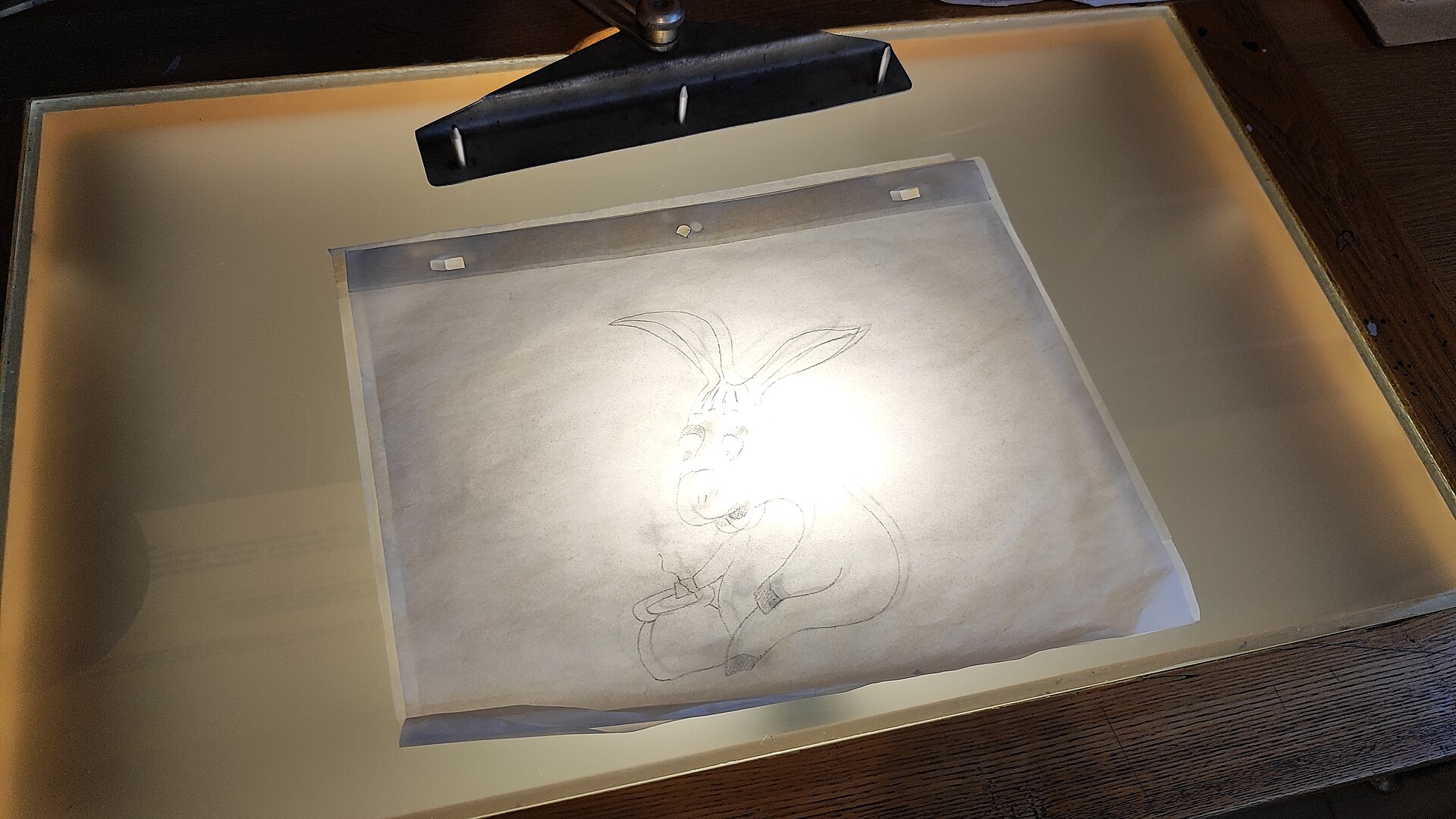
HOLLYWOOD — Winifred Trask, who for more than four decades traced and painted the drawings that became Saturday-morning cartoons, and who could ink a character’s eyelash without a tremor well into her seventies, died on Nov. 27 at her home in East Hollywood. She was 94.
Her death was confirmed by her niece, Coralie Odom, who said the cause was congestive heart failure.
Ms. Trask spent her working life in the ink-and-paint department, the mostly unseen and largely female workforce that turned an animator’s pencil roughs into the clean, colored cels a camera could photograph. She was an inker, which meant she sat at a glass-topped, lit-from-below table and copied each drawing onto a sheet of clear celluloid in India ink, a line at a time, thousands of sheets to a cartoon.
“People think the animator does the drawing and that’s the cartoon,” she told a community-college class she once addressed, according to notes her niece kept. “The animator does a smudgy pencil sketch. Somebody has to make it clean enough to shoot. That was us. We were the reason it looked finished.”
She came to the work in the years after the war, hired, she liked to say, because she could sharpen a pen nib and keep her cuffs out of the wet ink. She stayed at the same Hollywood cartoon studio for most of her career, riding the industry’s shift to the cheaper, faster television animation of the 1960s and outlasting several rounds of the layoffs that came with it.
The craft she practiced no longer exists. By the 1990s, computers had absorbed the tracing and painting she had done by hand, and the ink-and-paint departments emptied out. Ms. Trask took it philosophically. “The line I inked and the line a machine inks look the same on the screen,” she said. “But mine had a person behind it who could feel when the pen was about to skip. I’ll leave you to decide if that matters.”
Winifred Ada Trask was born in Bakersfield in 1931 and moved to Los Angeles as a young woman. She never married and had no children. She was known among younger animators as a keeper of the studio’s memory, the person who could tell you who had drawn what, and which shortcuts a director had insisted on and later regretted.
In retirement she taught herself watercolor, complaining that after a lifetime of filling in someone else’s outlines she was finally allowed to make her own. Her niece said the walls of her apartment were hung with small, exact paintings of the jacaranda trees on her block.
Besides Ms. Odom, she is survived by a grandnephew and a wide circle of former colleagues who kept up a monthly lunch that has thinned, year by year, to a handful.
The lunches will go on, Ms. Odom said. Someone has to remember who inked what.