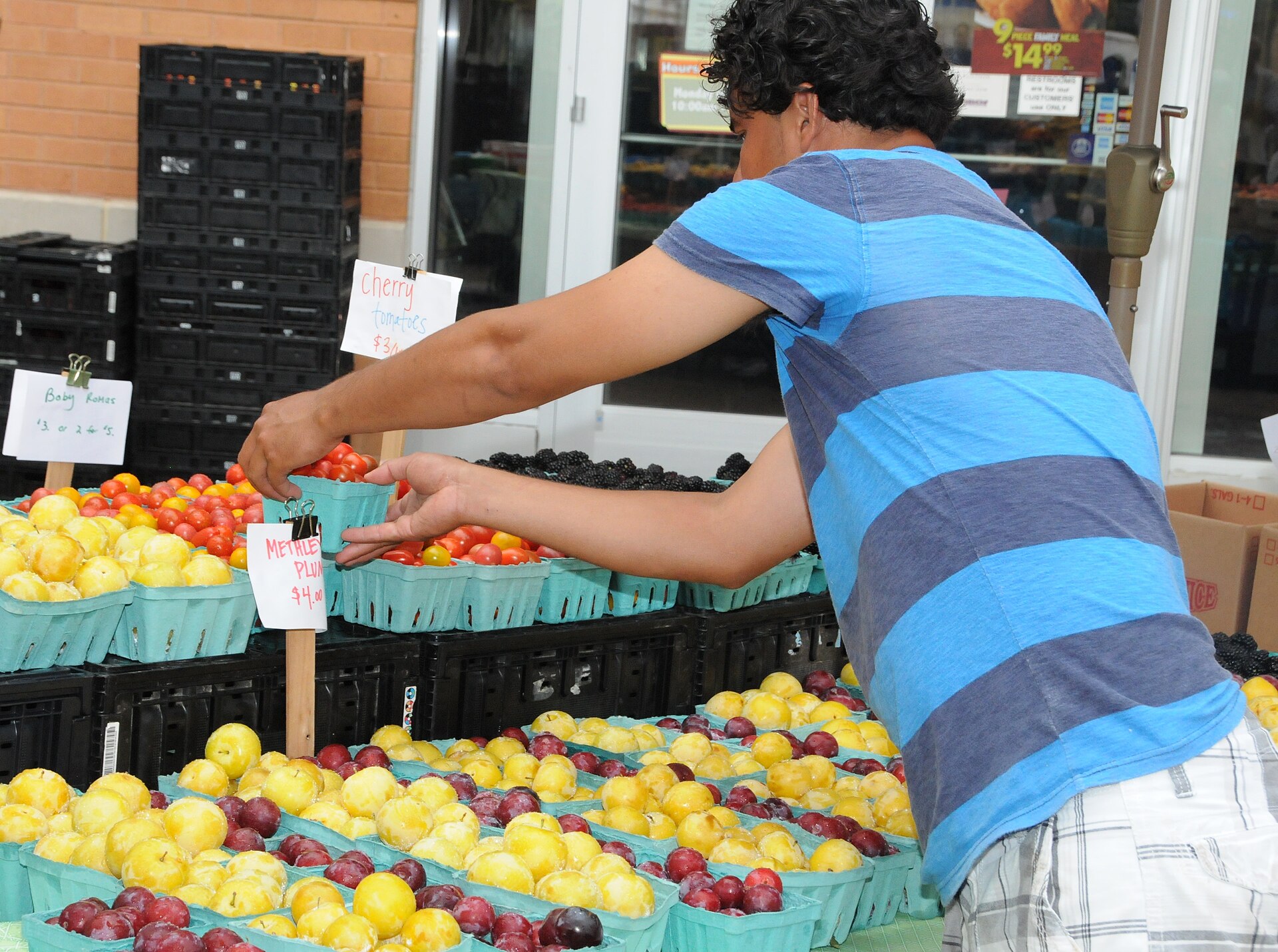
HOLLYWOOD — On Sunday mornings the block of Selma Avenue between Ivar and Cahuenga stops being a street. By seven the barricades are up, the canopies unfold, and a commuter cut-through becomes a slow river of strollers, canvas totes and dogs on too-long leashes, drifting table to table under a sky already going white with heat.
The Hollywood Farmers’ Market turned thirty-five this month, a milestone it marked with no ribbon and no speeches — only a slightly bigger crowd and a hand-lettered sign zip-tied to the Ivar barricade: THANK YOU, 1991–2026.
For a certain set of vendors, the number lands differently. They did not open the market. They were raised in it.
“I was six,” said Rosa Villanueva, 41, who now runs the stone-fruit stand her parents started that first summer. She was building a pyramid of Blenheim apricots that would not survive the morning rush. “My whole job was to hand people their change and not eat the inventory. I was bad at both.”
Her father drove down each week from a ranch near Fillmore in a pickup that, she said, “smelled like peaches for a week after.” He still turns up some Sundays, mostly to correct the way she arranges the table. The peaches, he maintains, are arranged wrong.
The market opened in the spring of 1991 as a modest civic experiment, one of a handful the city licensed to bring growers straight into neighborhoods that, at the time, had more vacant storefronts than grocery stores. Old-timers remember perhaps a dozen stalls and a great deal of empty asphalt.
“People forget how quiet the Boulevard was then,” said Priya Desai, 54, the market’s manager for the last nine years and a shopper for two decades before that. “This was a bet that people still wanted to stand around outside and buy a tomato from the person who grew it. Turns out they did.”
There are now more than seventy vendors on a good week, spilling north up Ivar. A second generation has moved behind the tables: the flower seller whose mother sold flowers; the bread baker who as a boy slept under the stand in a laundry basket and now runs three ovens; the honey man, third from the corner, who keeps the same hives in the same Sylmar foothills his father did.
Not everything has held. Rents have climbed, two longtime produce families have retired without successors, and the parking, everyone agrees, remains a small weekly war. A proposal last year to move the market to a lot off Sunset was floated, protested, and quietly dropped.
What endures is harder to itemize. On Sunday a woman bought the last of Villanueva’s apricots and mentioned, unprompted, that she had bought her wedding flowers at the stall two down, eleven years ago, from the same family.
Villanueva nodded as if this were ordinary, because at the market it is. Then she rearranged the peaches her father had rearranged, and waited for the next customer with exact change.