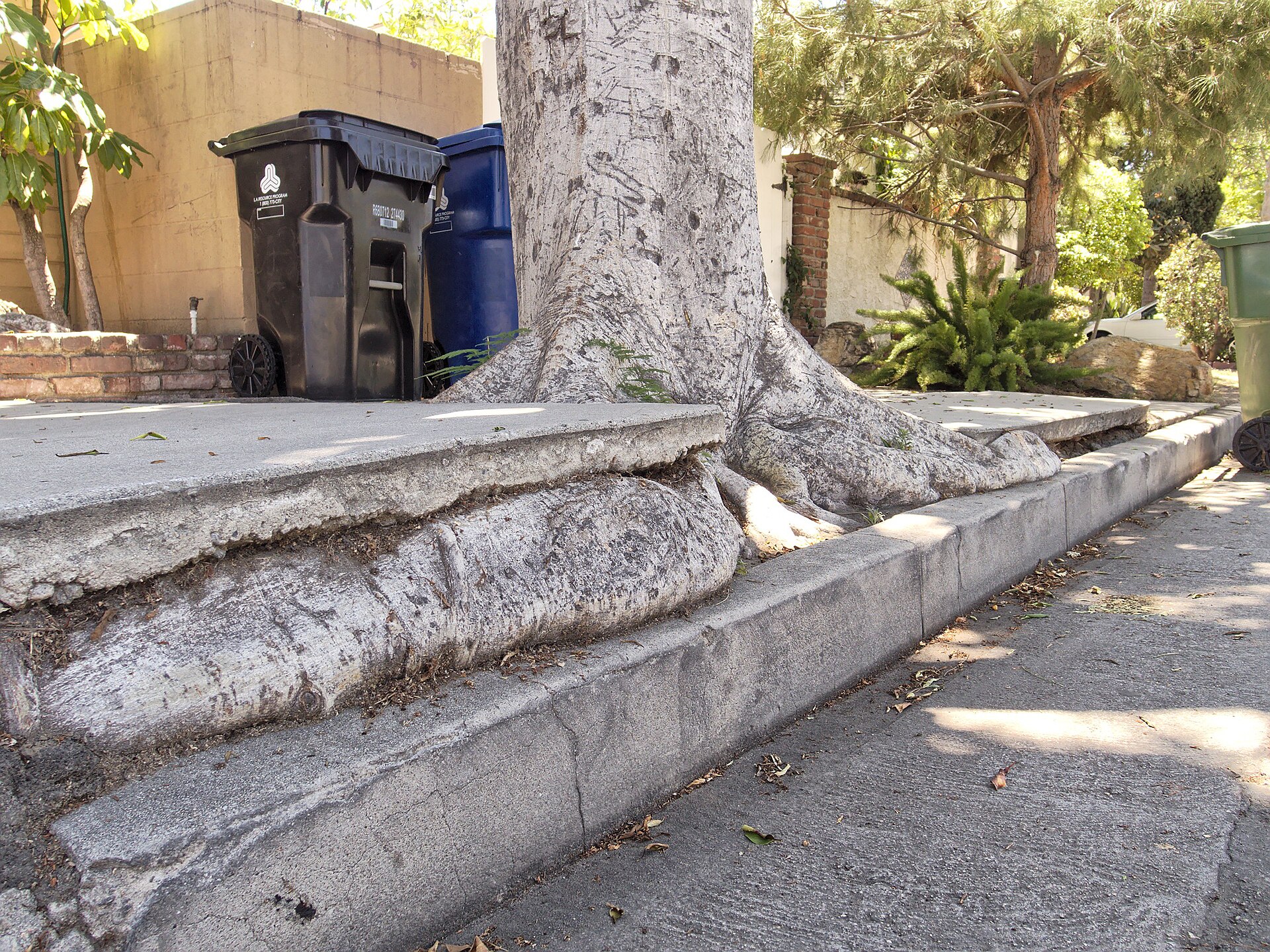
HOLLYWOOD — The tree had been on Carlton Way longer than almost anyone who lived there, and when the crew finished taking it down last week, the block was startled by how much sky it had been holding back.
The ficus, a broad old Indian laurel fig that had shaded the north side of the street near Bronson Avenue for the better part of a century, was removed by the city after its roots, thickened over decades, heaved the sidewalk into a series of ridges and cracked a section of curb and street. Two residents had tripped on the buckled pavement in the past year, one seriously enough to file a claim. An inspection found the tree healthy but the damage beyond patching, and the trunk itself beginning to lean.
That did not make the loss easier for the people who had lived beneath it. The ficus was the block’s landmark, the thing people gave directions by, the shade that made the west-facing apartments bearable in summer and the roost for a noisy parliament of crows that residents claimed to hate and clearly did not.
“I know it had to come down. I saw the sidewalk. My neighbor fell,” said Lucia Harrow, who has lived on the block for twenty-two years. “But I planted nothing, I paid for nothing, and that tree gave me shade for two decades. You don’t replace ninety years of a tree with a sapling and a press release. It’s going to be hot here now, and it’s going to stay hot for a long time.”
The city’s urban forestry division said the removal followed its standard process and that a replacement would be planted, most likely a species with a less aggressive root system better suited to a narrow parkway. Residents were told the new tree would go in during the next planting season. Several noted, without much comfort, that they would be old themselves before it threw any real shade.
The stump was ground out the same week, and the crew left a rectangle of raw dirt where the trunk had stood. By the weekend someone had set a potted geranium on it. By Monday there were three pots, then a hand-painted rock, then a laminated photograph of the tree in full leaf, tied to the fence behind it — the small, improvised shrine a neighborhood assembles when it has lost something it did not own but had come to depend on.
The crows have not left. They wheel over the block at dusk as they always have, circling the space where the canopy used to be, landing instead on the power lines and the roof ridges and the smaller trees down the street, complaining, and coming back the next evening to complain again.
City records suggest the ficus was likely planted in the 1930s, though no one is certain; the street trees of that era were often put in without paperwork. What is certain is the gap it left, a bright rectangle of afternoon light now falling on a stretch of sidewalk that had been shaded since before anyone on the block was born.