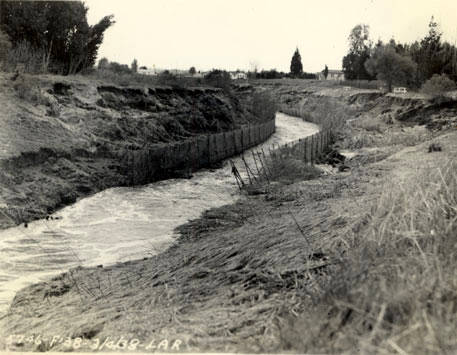
From the Times archive: first published March 4, 1938. Republished as part of the archive digitization project.
HOLLYWOOD — The rain began Thursday last and did not stop. By Wednesday the river had the bridges.
The Los Angeles River, running brown and full below the Cahuenga Pass, climbed its banks in the night and cut the roads north. The crossings at Barham and at the foot of Laurel Canyon went under before dawn. Two are gone.
No man here can yet number the dead. The wires are down. Word comes on foot and by radio. The county reckons its dead past a hundred, and the figure is not yet firm. It will climb.
In the canyons above the Boulevard the water came fast. Nichols Canyon and Laurel Canyon ran mud into the streets. Cellars filled to the joists. On the low flats along the wash, families woke to water at the bedstead and went out through windows into the dark.
The Red Cars stood still. The Pacific Electric tracks in the pass were under a foot of water by midnight, and the cars did not run to the Valley all the day. Autos were left where they stalled, doors open, and abandoned to the current. Some were found a mile down and half buried.
Neighbors took in neighbors. At a church hall on Gower a hundred slept on the floor, the women passing coffee, the men gone back out with ropes and lanterns to the houses still standing in the water. A grocer on Franklin threw his doors open and let the shelves go. “You do not sell a man bread in a flood,” he said. “You hand it to him.”
The dead are not the whole of it. Cattle drowned in the river bottom. Orchards below the hills lie under sand. A power crew worked through the night to hold the line into Hollywood, and held it, so that the Boulevard kept its lights while the flats went dark.
By Thursday morning the rain had thinned to a drizzle and the river had begun, slowly, to fall. Men stood on the high bank at Laurel Canyon and watched it go down, saying little. The water had taken what it meant to take.
The Red Cross has opened stations at the schools. Those with dry roofs are asked to make room. Those with boats are asked to bring them to the river. The count of the missing will be days in the making, and the count of the ruined longer still.
The rain, they say, is not finished. The hills are full. The river will bear watching yet.