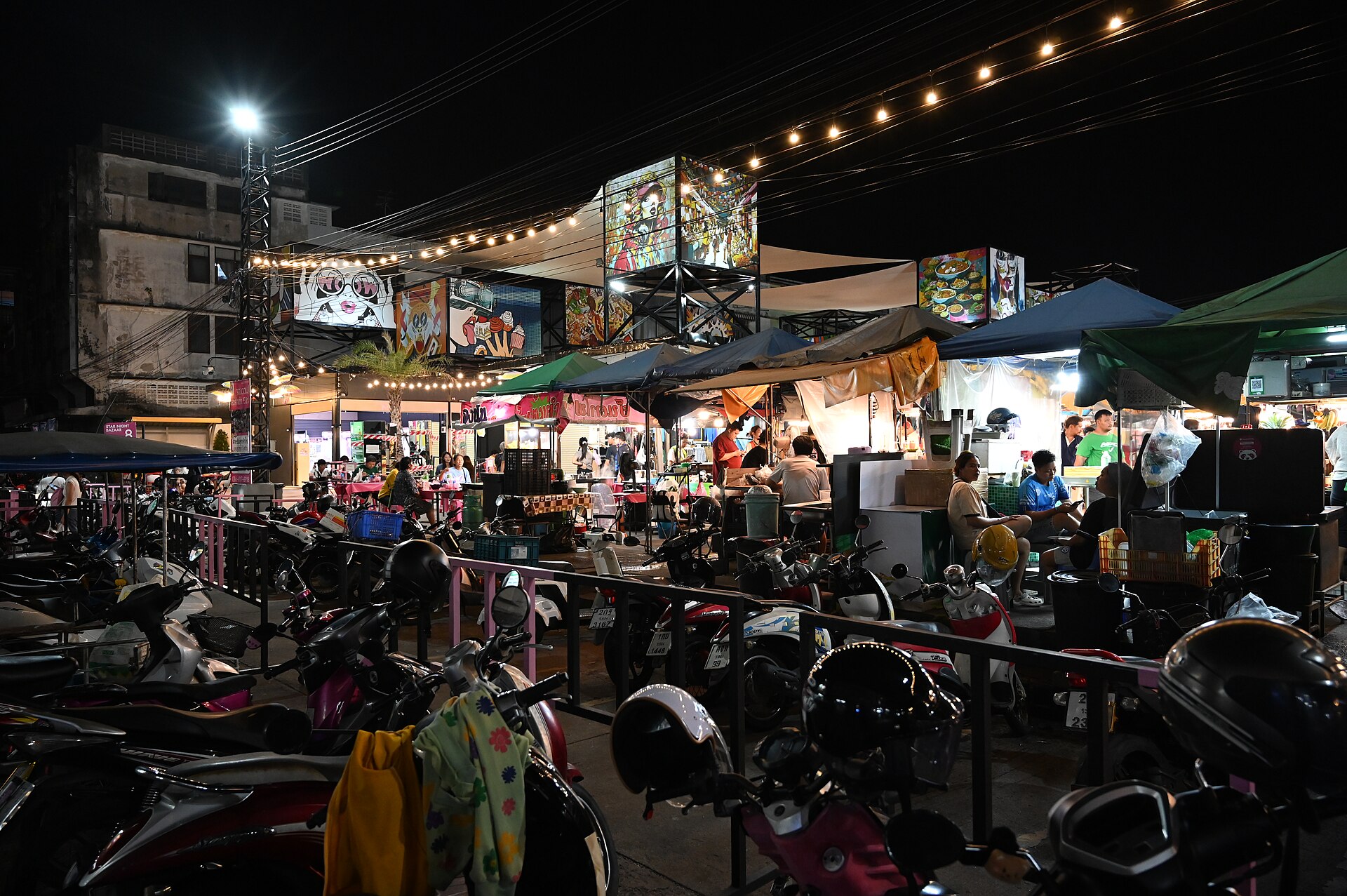
HOLLYWOOD — I went to the new night market on Cahuenga on its second Friday, mostly out of the reporter’s reflex to see a thing before forming an opinion of it, and I left with the opinion that it is good, and the suspicion that whether it stays good is not really up to the vendors.
The market itself is easy to like. Two rows of stalls, string lights overhead, food that smells better than the parking situation deserves, and a crowd that on the night I went ran the full range of the neighborhood — old couples, teenagers, families pushing strollers, a few tourists who wandered up from the Boulevard and could not believe their luck. For a few hours, a stretch of street that is usually just a route became a place people stood still in. That is not nothing. It is, in fact, most of what a neighborhood is: the places you stand still.
But a night market is an event that borrows a street, and borrowing a street carries costs the photographs never show. The residents a block over lose their parking and gain the noise. The shopkeeper with a lease and a light bill wonders whether the crowd spends anything inside a permanent store or only at the temporary stalls out front. Someone has to sweep up afterward, and someone has to pay for the extra hours the city puts in, and a pilot program is easy precisely because those bills have not fully come due yet.
Here is what I have learned watching these things succeed and fail in other neighborhoods. The markets that last are the ones woven into the ordinary business of the block rather than staged on top of it — where the corner restaurant runs a stall, where the residents upstairs were asked rather than informed, where the cleanup crew is a line in the budget and not an afterthought at midnight. The markets that fail are the ones that treat the neighborhood as a backdrop, borrow its street, take its picture, and leave the mess for the people who actually live there.
I will admit my bias. I have watched this neighborhood chase foot traffic for the better part of my career — through empty storefronts, through plans that died in committee, through more than one grand reopening that reopened onto nothing. Given the choice, I would rather it chase that foot traffic with food stalls and string lights than with another vacancy. So I am rooting for this. Rooting is not the same as trusting.
So a few asks. To the organizers: keep talking to the people who live above and beside the market, and keep talking after the novelty wears off, which is exactly when you will stop wanting to. To the city: do not let a good idea die of a permit renewal, and do not pretend the cleanup pays for itself. And to the rest of us who go: spend money at the market, yes, but spend it too at the shop whose sidewalk the market is standing on.
A neighborhood is not built in an evening, however well lit. It is built on the Tuesdays, when the lights are down and the street is just a street again. I will go back to the market. I will also be watching what it leaves behind on the mornings after.